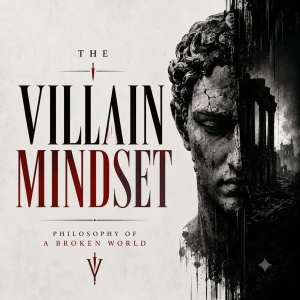
The Villain Mindset
The Villain Mindset examines iconic villains from anime and film to uncover the philosophies underlying their worldviews. Each episode pairs a villain archetype with thinkers such as Schopenhauer, Nietzsche, Aristotle, Machiavelli, and Kant. The show focuses on original cinematic storytelling and philosophical analysis rather than plot recaps or recycled audio. It explores how villainous logic can feel uncomfortably close to our own. New episodes are released weekly.
Episodes

“What Villains Teach Us About Ourselves” (Season Finale)
Eleven villains. Eleven philosophies. Eleven different roads to the same starting point: someone convinced they were right. This is the Season 1 finale of Villain Mindset — where we connect every archetype and philosopher from the season into one argument. From Schopenhauer’s pessimism to Arendt’s banality of evil, every villain this season shared the same throughline: none of them were born like
He Never Hated Anyone. That’s What Made It Worse
He never hated anyone. That’s the part people find hardest to accept. He didn’t design the cruelty he carried out — he just followed orders, filed the reports, kept the machine running. This episode traces the mind of someone who wasn’t a monster, but something far more unsettling: ordinary. We break down Hannah Arendt’s “banality of evil” — her disturbing conclusion, drawn from the trial of a Naz
He Never Lied. He Just Controlled What Was True.
The most effective control was never force. This episode traces the mind of someone who understood that you don't need to chain people to control them — you just need to control what they believe is real. We break down Michel Foucault's idea of power/knowledge: that power isn't just imposed from above, it operates through institutions, language, and whatever a society accepts as "true." Control th
When the System Fails, Who Gets to Break the Rules?
Every system of law makes a promise: follow the rules, and you’ll be protected. He watched that promise fail — the guilty walking free because they knew the right people, or hid behind the right title. So he decided to deliver justice himself. This episode traces the mind of an outlaw who stopped trusting the social contract everyone else still lives by, through the lens of two philosophers who ne
He Looked at the Void and Chose to Burn It Down
Some villains want to burn the world down because they hate it. This one wants to burn it down because he’s done pretending it means anything at all. This episode traces the mind of someone who watched the same cycle of hope and ruin repeat until hope stopped looking like courage and started looking like a joke. We break down Albert Camus’s philosophy of the Absurd — the collision between our need
The Boy His Mentor Made and Broke
There's a specific kind of ruin that only someone you trusted can cause. This episode traces the mind of someone who lost more than a mentor — he lost the entire framework he used to understand right and wrong. We break down Sartre's radical freedom and his unsettling idea that we're all "condemned to be free" — responsible for who we become, whether we want to be or not. No recaps, no reused audi
The Math of Choosing Who Lives
He didn’t want to rule anything. He wanted to end something, so that something else could survive. This episode traces the mind of someone who believed the greater good was worth any price — as long as he decided who paid it. We break down the collision between utilitarianism’s “greatest good for the greatest number” and Kant’s insistence that people must always be treated as ends in themselves, n
The Cold Math of the Mastermind
By the time you notice him, you’ve already lost. This episode traces the mind of a mastermind who never raised his voice — someone who learned that patience beats force, and that being good and being effective were two entirely different jobs. We break down Machiavelli’s real philosophy in The Prince — not “the ends always justify the means” as most people misquote it, but a much sharper argument
What Happens When Winning Stops Working
He beat every rival. Broke every ceiling. And felt nothing. This episode traces the mindset of a warrior born into greatness and raised as a weapon — someone taught that his worth was a number that could always go up, and always go down. We break down Nietzsche’s “will to power,” the idea that the drive to grow and overcome resistance is the engine of being alive itself — and the moment his ambiti
The Banished Prince and Aristotelian Virtue
He had one job: bring back proof of something impossible. He didn’t — and the answer was always the same word: “No.” Episode 3 follows a prince banished for mercy, chasing an impossible quest to earn his father’s approval — and the 2,000-year-old philosophy that explains why he couldn’t stop. We break down Aristotle’s virtue ethics from the Nicomachean Ethics: honor (timē) as a byproduct of virtue
Light Yagami and the Ethics of Playing God
He was handed the power to kill anyone, from anywhere, without consequence — and the only rule was his own conscience. He used it thousands of times. And he never once believed he was the villain.This episode traces the terrifying logic of a brilliant student who decided he could judge the entire world, and the real philosophy that explains exactly how that happens. We break down utilitarianism’s
Inside Madara Uchiha's Mind: The Terrifying Logic That Changed Everything
What if the greatest villain in wasn't driven by hatred but by compassion taken to its most dangerous extreme?In this episode , we explore the psychology and philosophy of Madara Uchiha, a man who believed humanity could never achieve peace through freedom. After witnessing endless war, betrayal, and suffering, Madara concluded that the only path to lasting peace was to remove choice itself.Was th